Week Six: Life and Death

Published on 2026-07-12 on LinkedIn
Posting from: The home office
Drinking: a steaming mug of Pike Place Roast
When I started writing about a month ago, I had a vision of doing it outside. In nature. Listening to the birds. Feeling the breeze. The total opposite of the typical work environment.
Great vision. Not ideal for me, though.
I do think better in nature. I think better while moving. I come up with most of what I want to write about on the back deck.
But the writing itself is way easier for me on a full size clickety-clack keyboard in front of a big giant monitor.
The spirit of the Back Deck is in the writing, but the writing will primarily happen at the computer.
How Long Is This Sabbatical?
I use the term “sabbatical” instead of retirement as I am hedging my bets. It is a dumb hedge.
The only monetizable skill I think I have is picking stocks and maybe wealth management.
If I truly am good at those things, we will likely not run out of money, and I can be my own boss until I die.
If I stink, I am looking at greeting you as the doors of Wal-Mart slide open. I wouldn’t even think of trying to talk someone into trusting me again with other people’s money.
Option three, however, is learning new interesting things, getting good at those new things, and creatively combining those things into a way to help people think through and solve their problems.
For now, there is no pressure to make option three an economically viable venture, so I can indefinitely call myself the “Explorer of the Interesting” here at the Back Deck Institute.
So, When Will I Die?
A key planning assumption in any piece of retirement planning software is your age at death (and if you are married, your spouse’s, too). Weirdly, assuming you will live a long time is a pessimistic assumption as it means you will have more years of expenses to fund.
When it comes to planning, I follow the adage, “plan for the worst and hope for the best”. If the worst is I live to an old age and am still able to spend a lot of money doing fun stuff, what on earth is the best? In this case, the worst is the best, so I’ll both plan for and hope for the worst.
In my plan, I keyed in me dying at 95 and MJ at 96. Why? I don’t know anybody in my family history who lived that long, but at the same time, my parents are in relatively good health in their late 80’s. I’m in good health now and I plan to keep that going. Staying healthy was a major reason I left the workforce. More on that later.
I assume MJ will pass two years after me. She is a year younger. She is healthier than me. Always active. Walks for miles when nourishing her customers at the restaurant she works at. Dances for miles during her three-hour concerts as the lead singer of Crucible. And runs for miles to get away from me as I chase her around like a crazy caveman.
So, there is no way I will outlive her. I wouldn’t last long if I did as I wouldn’t know where anything is while the quality of my decisions would decline markedly without my most trusted advisor around. Thus, she has to die after me. But not too far after me because I would miss her too much in Heaven.
Maximizing Healthspan
Another key variable for retirement planning is what you will spend your money on and when.
When you are healthy, you will spend more because you will want to do stuff. Doing stuff can get expensive.
Planning to be healthy longer, or stretching out healthspan, is planning for the worst and hoping for the worst. The duration of high discretionary spending gets elongated well into your 70’s.
We are planning for the worst.
Leaving full time work allows me to immediately get to work on extending my healthspan. I do this via the power of math…subtraction and addition.
Subtract:
1. Stress
2. Sitting most of the day
3. Convenient restaurant meals or takeout
4. Being inside
Add:
1. Sleep
2. More exercise
3. More movement
4. More nutritious food
5. Better relationships
6. Being outside
Instead of choosing between one more hour of sleep or getting my ass out of bed to work out, I can now do both. I am no longer glued to my workstation in case somebody or something needs my attention. I control what I stress about (still working on that). I have time to give friends and family my full attention. I can be thoughtful about what I eat and drink (still working on that…the Cheez-Its are always calling me).
The bottom line is this sabbatical or retirement is increasing the chance that I’ll have more years of spending and more years of high spending. The worst 😊!
Exercise or Training?
I’ve been lucky to have a couple of conversations with old friends over the past week or two that have turned me on to maybe doing some hard things. I’m hoping I will follow through and level up my exercise into training. I consider the purpose of exercise to be healthy. The purpose of training is to do something more specific. Training may be easier to stick with as there is a more tangible purpose.
I’m not particularly athletic, I hate running, and I don’t like risking my life. So hard things for me rules out things like senior basketball, an Iron Man event, or free soloing El Capitan.
29029
My first conversation was with my friend Pat Dawson who told me he is training for an event called 29029 that will take place after he retires. 29029 is the height of Mt. Everest, in feet. You can imagine what the event entails. Specifically, the organization leases a ski resort and participants climb up the ski hill (and gondola back down) enough times to climb the equivalent of Mt. Everest within 36 hours.
Intense, but it only requires the ability to walk and is not life threatening.
Pat has always liked to do hard things, and I admire him for that. I grew up with Pat and he is a year older than me. As I’m talking to him about it, I’m thinking there is no excuse for me to not consider it. I haven’t signed up yet…he tells me it is hard to get a spot in one of their events…but I intend to begin training on the hilly trails of Western Pennsylvania to see how my body responds.
If you want to learn about 29029 yourself, the origin story is very interesting. Linked here.
The 12-Hour Walk
Pat and I also discussed an author / adventurer we both happen to admire…Colin O’Brady. Colin is best known for being the first person to solo hike across Antarctica using only human power. He also wrote a book, “The 12-Hour Walk“, that encourages readers to schedule and walk for 12 hours on any route with the phone on airplane mode, using only maps. This might be a good test to see if 29029 is possible, not to mention a great physical and mental reset on its own. Check it out here.
Get Up and Ride
My second conversation was over coffee with my friend, Jim Shea. Jim is an author himself, and the first book I read after I started my post-work life was the first book he penned, “Get Up and Ride: a story of two friends and a cycling adventure on the Great Allegheny Passage and C&O Canal”. We got together after I finished the book and started his second book, “Get Up and Ride: The Camino de Santiago - A Cycling Adventure Story”.
I thought the first book would be a simple guidebook about a trail I might want to try. That would have been a win for me.
Instead, it was a well-timed enlightening story of two friends, Jim and his brother-in-law Marty, who embody much of how I want to live my life. It turns out that Jim is like my brother from another mother. He is a meticulous planner with a good sense of humor. Marty is Jim’s best friend and brother-in-law who teaches Jim to chill, convincing him to ditch his watch and his calendar. They make a great team.
I aspire to be a blend of Jim and Marty and be able to tell gut busting stories the way Jim tells them. To do that, I need to live life in a way to have stories to tell. Jim inspired me to do that. Thanks, Jim!
If you read the books, not only will you learn the ins-and-outs of planning and being on a bicycle adventure, but you will learn about the interesting history of the places Jim and Marty see along the way (in Spain, we are talking Middle Ages and the Roman Empire while in Pennsylvania and Maryland it is all about the French and Indian War, the Civil War, and the Industrial Revolution). All while being wildly entertained. I can’t recommend the books enough.
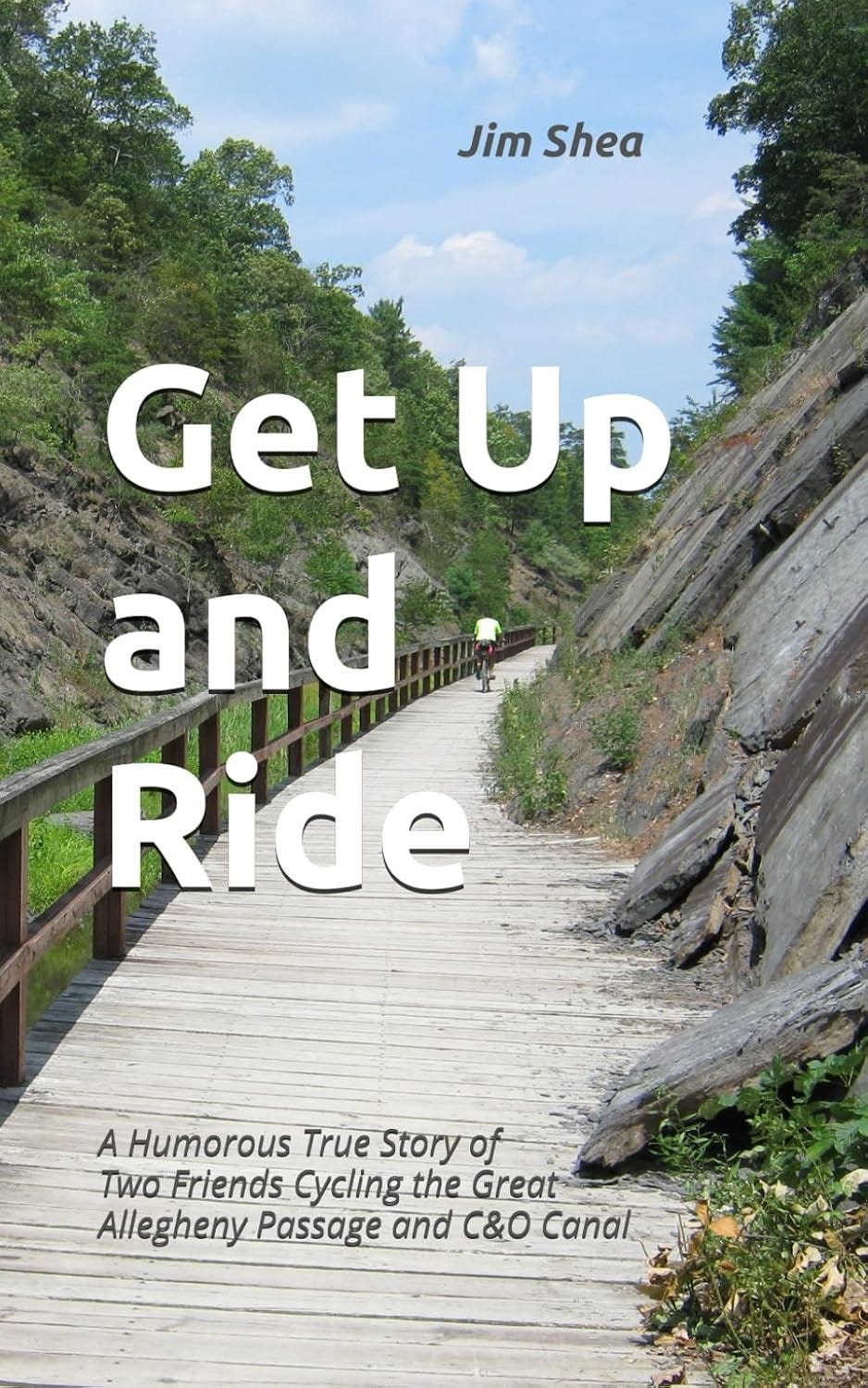
Add riding the Great Allegheny Passage and walking (you’ll see why not cycling if you read the second book) the Camino de Santiago to my possible list of hard things.
Have a great week!
Steve
Discussion about this post