The Spans

Published on 2026-08-16 on LinkedIn
I might spend too much time learning and thinking about how to live a good life. I think it comes down to three simple, interdependent concepts:
Lifespan: live long. Healthspan: be healthy for a long time. Joyspan: enjoy life for a long time.
The spans don’t technically need each other. It is quite possible to be a chain-smoking couch potato and live to 100. It is possible to be an elite triathlete and be lonely because of the training regimen. It is possible to discover pure bliss at a monastery in Nepal and then blissfully trip and fall over a cliff on your way down the mountain.
For me, I’d like all three.
None of the spans are totally controllable. Shit happens. You can only do what you can to maximize each one.
Fortunately, the spans also reinforce each other. Working on one will likely help with one or more of the others. That’s where the idea gets interesting.
For someone in an older cohort like me, there is also leverage. I’m 58 years into this life experiment. Maybe I have 30 years of lifespan left, 20 years of healthspan, and hopefully 30 years of joyspan. If I could extend each by three years, I would increase my remaining lifespan and joyspan by 10% and my healthspan by 15%.
If I were 28 and used the same assumptions, a three-year extension of each span would make a 5% difference to lifespan and joyspan and a 6% difference to healthspan. Twenty-eight-year-old me had other things that seemed more pressing than thinking about spans.
Lifespan
According to the CDC, life expectancy at birth in the U.S. is 81.4 years for females and 76.5 years for males.
Do not use these numbers for retirement planning. If you make it to 65, the CDC says females will likely live another 20.8 years, or roughly to age 86, and males another 18.4 years, or roughly to age 83.
Adjust your own number up or down depending on your circumstances. Add a few years of cushion so you don’t run out of money. Or buy a lifetime annuity to supplement Social Security. Then adopt—and hopefully continue—habits and practices that might extend your lifespan further.
An interesting book on the topic that I read in 2020 is Lifespan: Why We Age—and Why We Don’t Have To by David Sinclair.
Sinclair argues that aging should not necessarily be inevitable and presents the idea that aging could be treated more like a disease. He theorizes that aging is the root cause of many fatal diseases and argues that the key to longevity lies in activating our “survival circuit,” a set of longevity-related genes called sirtuins that help the body respond to stress and focus on cellular repair.
With plenty of overlap with healthspan, Sinclair lays out five strategies for maximizing longevity:
1. Practice dietary restriction by eating less often.
Whether through intermittent fasting or calorie restriction without malnutrition, Sinclair argues that giving the body periods of hunger engages the survival circuit, telling genes to boost cellular defenses and slow aging.
I have a rule that I don’t eat until at least noon, and I try not to eat anything after dinner. But, as I’ve said before, the Cheez-Its often call my name.
I’ve tried 24-hour fasts. They’re certainly doable, but they take some of the fun out of life.
2. Prioritize high-intensity exercise.
While any movement is good, Sinclair argues that intensity matters when it comes to engaging longevity-related mechanisms. High-intensity interval training (HIIT) that raises your heart rate to the point of heavy breathing creates a “hypoxic response” that may activate the body’s natural defenses against deterioration.
I need to do a better job of this.
If you live in Western Pennsylvania, walking fast up your local hills will do the trick. If you live in central Ohio, you’ll have to hit the gym or look goofy sprinting through your neighborhood.
3. Shift toward a plant-based diet.
What we eat is just as important as when we eat. Research highlighted by Sinclair suggests that vegetarian diets are associated with lower rates of cardiovascular disease and cancer.
Sinclair personally aims to eat a lot of plants and avoids eating other mammals to support his healthspan. I do try to incorporate a lot of plants into my diet, but I also love animal-based protein.
For more on the benefits of plant-based eating, I enjoyed How Not to Die by Michael Greger, MD, and Finding Ultra by Rich Roll.
4. Expose your body to temperature extremes.
Exposing the body to discomfort can trigger survival mechanisms. Frequent sauna use has been associated with lower rates of heart disease and all-cause mortality, while staying on the cool side during the day and night may stimulate other longevity-related mechanisms.
I have not tried the sauna, but I do try to finish my morning showers with a minute or two of cold water.
The easiest rule of thumb is simply not to let the weather scare you from going outside, whether it’s summer or winter.
5. Minimize DNA damage and toxin exposure.
Protecting your “epigenetic clock” means being wary of environmental hazards. This includes avoiding microwaving food in plastic, which may expose you to chemicals, as well as limiting unnecessary exposure to X-rays, UV rays, and heavy air pollution.
There is only so much you can do to avoid air pollution, especially if you live downwind of fire country. But switching to glass containers when reheating food is about as simple as it gets.
Sinclair also discusses some supplements that might slow or even reverse aspects of cellular aging, although the evidence remains preliminary.
I’m happy someone is doing the work on that, but I’m not sure immortality is in my future.
Healthspan
Dr. Peter Attia, in his book Outlive, defines healthspan as the period of life spent in good health and free from chronic disease and cognitive or physical disability. In other words, it’s your ability to thrive for as long as possible.
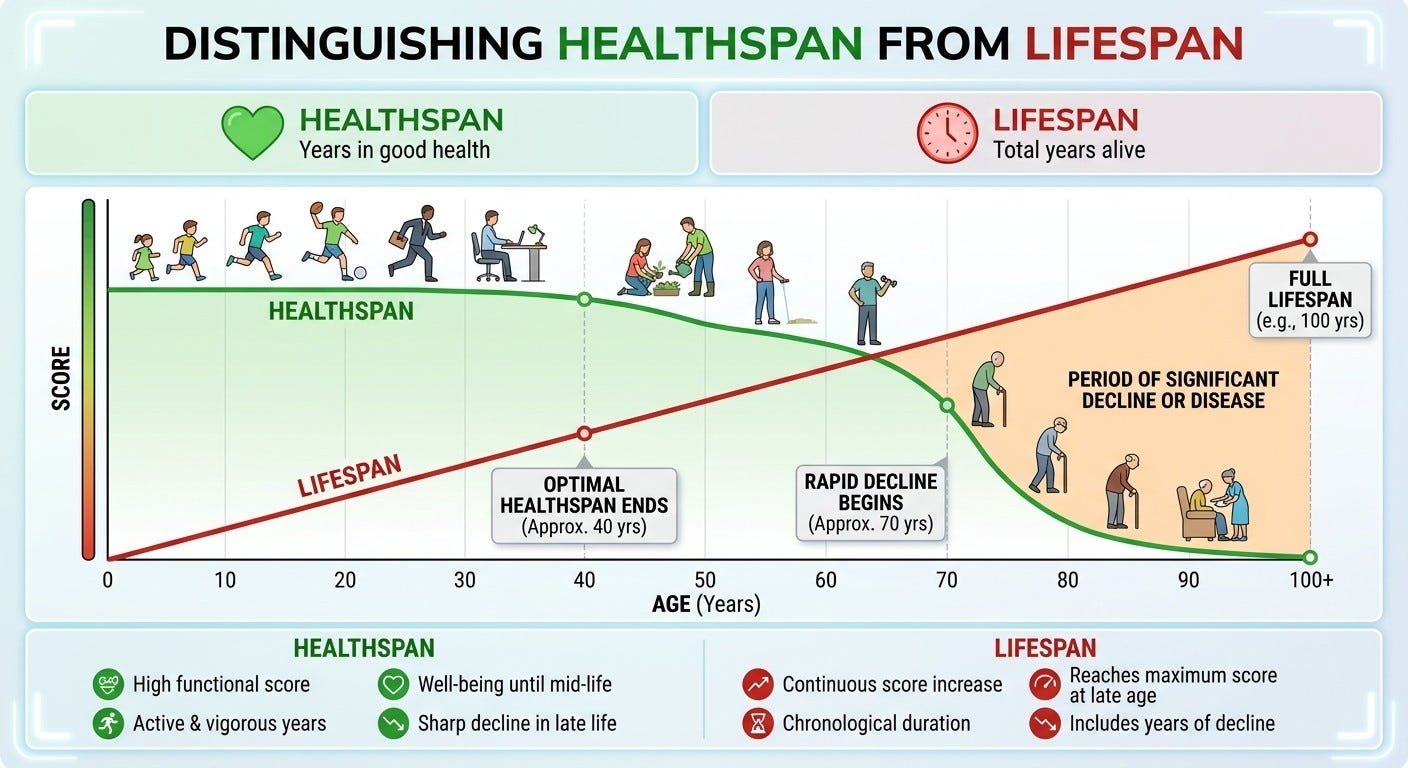
The objective of lifespan is straightforward: extend the red line.
The objective of healthspan is to keep the green line elevated and maximize the area under the curve.
If you do nothing to extend healthspan, when you decide to retire matters a lot. Physical and cognitive decline are inevitable eventually. How many years of healthy retirement you get depends in part on how long you can keep the rapid-decline phase at bay.
That will influence your financial plan, but more importantly, your quality of life.
Attia’s book is a seminal read on healthspan. He introduces the concept of “Medicine 3.0,” which focuses on prevention and extending healthspan, versus “Medicine 2.0,” which focuses more on diagnosing and treating disease after it appears.
I especially appreciate Attia’s framework called the “Centenarian Decathlon,” which applies the philosophy of a decathlete to aging.
It starts by thinking about and making a list of what you want to be able to do in your later years.
Want to lift a 20-pound carry-on into the overhead bin so you can continue to travel? Carry your own groceries? Lift your toddler grandchild? Go on an outdoor hike?
Then you need to train for those things now.
Build exercises into your current training that will allow you to do the things on your list, recognizing that your abilities will naturally decline.
For example, if you want to be able to lift 20 pounds at age 90, you should be training with 50 pounds at age 60—or working your way toward it. If you want to lift your grandchild, do squats.
In short, be intentional with your health decisions today so you can live a great life for as long as possible.
Even shorter: read the book.
Joyspan
According to Dr. Kerry Burnight in her aptly titled book Joyspan, joyspan is “the experience of well-being and satisfaction in longevity.”
While lifespan measures the quantity of your years and healthspan measures the physical quality of those years, joyspan focuses on how many of those years you actually enjoy.
Burnight describes joyspan as cultivating internal strength—the capacity to grow, connect, adapt, and give throughout our lives.
Her core ideas for maximizing joyspan include:
1. Commit to lifelong growth.
Shift your mindset from seeing aging as a decline to seeing it as continued growth. Cultivate curiosity by seeking new knowledge and unfamiliar experiences simply for the joy of discovery.
That’s one reason I enjoyed my years as an investment analyst so much, and why I’m committing to stay curious in my post-work years.
2. Nurture deep connections.
Social bonds are important to longevity and well-being. Make it a priority to build and maintain relationships that provide support, companionship, and a sense of belonging.
This can be a challenge for retirees because our social networks get upended. But I suspect the relationships that remain will become more meaningful and less transactional.
3. Practice adaptation.
Life will inevitably bring challenges. Adaptation requires the flexibility and creativity to respond to change in a way that allows you to continue functioning and finding meaning.
If you can go with the flow, you can extend joyspan to your last breath and find meaning even after your healthspan begins its inevitable decline.
4. Give of yourself.
Regularly offering your time, skills, or compassion can create a sense of purpose. Whether through mentorship or small acts of kindness, giving can also make you feel better.
My best days at work were the ones when I thought I’d helped somebody learn something. I hope to keep stacking days like that indefinitely.
5. Integrate joyful habits.
Incorporate practices like gratitude, mindfulness, and laughter into your life. These aren’t mere luxuries. They can help build emotional resilience and make it easier to recover from setbacks.
By focusing on joyspan, you increase the odds that the extra years added by modern medicine will actually be worth living.
As Burnight puts it, the goal is to engage fully in life—mentally, physically, socially, and emotionally.
The Overlap of the Spans
If you maximize healthspan, it seems likely that you’ll also increase lifespan. Less obvious is the relationship between joyspan and healthspan.
There is growing evidence that positive emotional states and strong social connections are associated with better physical and cognitive health. The relationship appears to run in both directions: being healthier can make it easier to enjoy life, and a more engaged, connected life can support healthier behaviors and outcomes.
That creates several potential feedback loops:
1. Immune and cardiovascular health.
Positive emotional states have been associated with better cardiovascular outcomes and other measures of physical health.
2. Stress mitigation.
Joyful experiences can help regulate the body’s stress response. Chronic stress is associated with a range of adverse health outcomes.
3. Cognitive resilience.
Staying socially and mentally engaged may help protect cognitive function as we age.
4. Behavioral reinforcement.
People who regularly experience positive emotions may be more likely to engage in healthy behaviors such as exercising, eating well, and getting adequate sleep.
And it is easier to be joyful if you’re healthy.
If I put this post into an Excel worksheet, I’d get the dreaded circular-reference error. But in this case, that’s an error that’s built into the model by design.
Embrace it.
Live a long, healthy, and joyful life.
Have a great week!
Discussion about this post