The Body Caught Up

Published on 2026-08-02 on LinkedIn
I officially retired June 4th. My brain knew I was retired, but I felt weird for the first couple of weeks…like I lost a limb and it was still there.
I mentally adjusted OK after that, but I still didn’t feel retired. I didn’t feel like I deserved it. I’m too young to be retired. Society demands that I work.
My body followed that feeling, not allowing me to sleep restfully. I got the night sweats. I woke up even earlier than I did for work…no matter what time I went to bed. My stomach muscles were still a bit tight. My breathing wasn’t calm. I still felt weight on my shoulders.
Fortunately, I had many wise friends who have been reading my posts advise me that this is normal. Especially for earlier than expected retirements.
I was able to avoid compounding the tightness of the body by keeping my mind aware of what is normal. I did no more than that.
This week, without doing anything different, my body surrendered. It is now retired, too. I sleep soundly. My muscles feel more like butter than taut ropes. I’m belly breathing. I’m present.
When you retire and if you don’t feel the relaxed bliss right away, if you are like me, maybe week eight or nine will be your time. Just know that it’ll come eventually. You don’t have to do anything except believe.
Back Deck Budgeting
July 2026 was a proof-of-concept month.
I think we came in a bit under budget without consciously doing any belt tightening or otherwise changing habits. Car repairs were a bit heavy, a graduation party for Charlie (congratulations, buddy!) puts us over on entertainment expenses, but we didn’t travel and I paid my first COBRA premium in June for July coverage. These largely offset each other while other expenses were slightly below budget, which I attribute to conservative planning rather than miserly spending.
I have tracked of our spending by category in Empower (formerly Personal Capital), and before that Quicken, since 1991. I haven’t kept or lived within a formal budget, however, since I was single. It was important to get a month under our belt to know what spending in line with the budget FELT like.
It was fine.
More importantly, I have confidence that the numbers reflect reality.
My withdrawal rate (annual transfers from the investment portfolio divided by the beginning balance of the investment portfolio) plans based on the budget are as follows:
· 2027: 4.9% (high taxes for planned Roth conversions)
· 2028: 4.8% (high taxes for planned Roth conversions…drops due to portfolio growth)
· 2029: 4.7% (high taxes for planned Roth conversions…drops due to portfolio growth)
· 2030: 3.8% (begin Social Security distributions…high taxes for planned Roth conversions…drops due to portfolio growth)
· 2031: 3.7% (high taxes for planned Roth conversions…drops due to portfolio growth)
· 2032: 3.9% (assume MJ stops working…continued high taxes for planned Roth conversions offset by portfolio growth)
· 2033: 3.6% (pension payments from a long ago job start for me…Medicare kicks in for me)
· 2034: 3.2% (pension payments from a long ago job start for MJ…Medicare kicks in for MJ)
Note that the maximum “safe” withdrawal rate, or “SAFEMAX”, according to financial planner Bill Bengan, is now 4.7%. The SAFEMAX is based on historical simulations of a retiree running out of money over a given thirty-year horizon based on a 60% stocks / 40% bonds investment portfolio.
Simply put, a retiree investment portfolio would last thirty years under the worst historical condition. In this case, it belonged to a person who retired on October 1, 1968. This was driven by a combination of high starting stock market valuations and the severe inflation that persisted throughout a significant portion of that 30-year retirement window.
Also, the SAFEMAX assumes the retiree withdraws 4.7% in year one and automatically increases the annual withdrawal by the annual inflation rate.
In reality, a retiree will make adjustments as conditions change.
What adjustments would I make if conditions get hostile and look like they are going to stay that way?
The first line of defense is I’m already prepared with five years of dedicated cash. The risk is inflation for my specific spending basket runs higher than my forecast (3% in 2027, 2.5% in 2028, and 2.25% per year thereafter). Then, the maturing cash will not be enough.
So, the second line of defense is what anybody would do…change the spending basket with as small as possible change in quality of life.
The third line of defense is to cut spending from “ideal” levels to “base great life” levels, starting with categories that aren’t all that important to us (e.g. if due for a new car, push it a year or two; domestic travel instead of international travel; road trips instead of plane trips; pork instead of beef, etc.).
The fourth line of defense is to slow Roth conversions to reduce the cash outflow to taxes.
The fifth line of defense is recreational employment (e.g. photography gigs, drive a school bus, teach a class…anything fun).
The sixth line of defense is to downsize the house. This is something we will eventually do when we are too old to properly maintain it. This will cut property taxes, utility bills, maintenance, etc.
The seventh line of defense is to re-enter the workforce or start a business in some capacity.
Bottom line: 4.7% is the magic number for the retiree who plows ahead stubbornly. The SAFEMAX is probably 5-6% for the retiree who is willing and able to adjust.
Back Deck Investing
If I was sleeping during week three of earnings releases, I would have thought markets were unexciting. The Vanguard Total World Stock ETF, VT, was up 0.53% while the Schwab US Dividend Equity ETF, SCHD, was down 0.18%.
Daily, and especially intra-day, swings were violent, however. A $45 billion hedge fund managed by a 24-year old whiz kid had to liquidate due to margin calls, selling its public equity positions to Citadel Securities at a 10% discount.
If you were in an active strategy, you may have had either a really good or really bad week. The diversity of outcomes, even within sectors, was staggering…
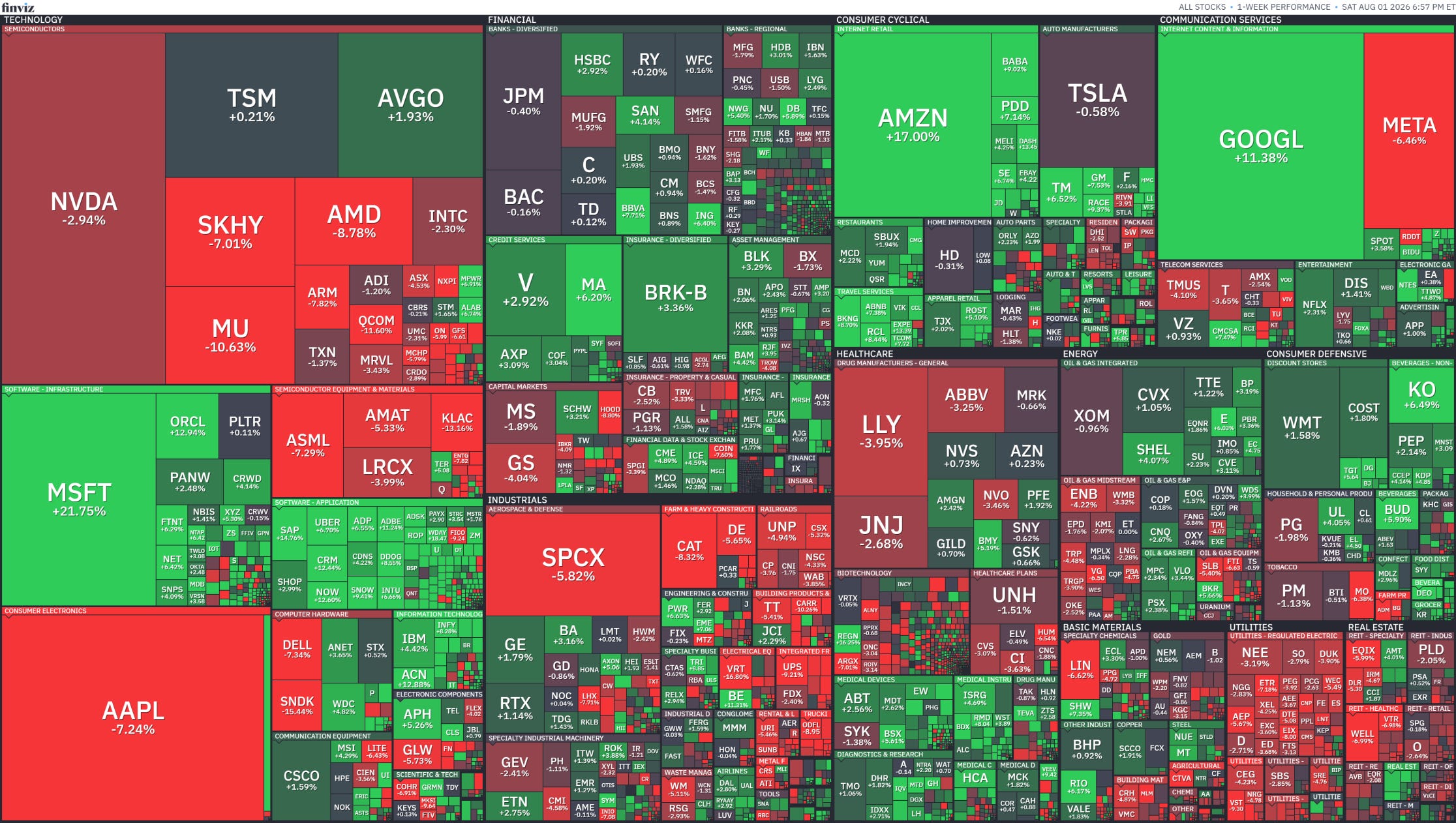
Courtesy of Finviz.com
Among the big four earnings reports, Amazon and Microsoft delivered outstanding cloud services results and shares rallied despite heavy capital expenditures. Apple warned about rising memory costs and difficulties of procuring adequate memory chip supply. Meta keeps raising capex estimates to compete in AI without much in the way of tangible results while its advertising business continues to excel.
It is unclear how much stock action reflects unwinding of leverage, either via outright borrowing or long positions funded with short positions.
What is clear is that AI demand continues while providers are willing and so far able to increase supply. This is unambiguously bullish for most businesses, and ultimately consumers, as intelligence gets cheaper, more available, and more accessible.
Those companies that are in the food fight to train the latest and greatest LLM, however, may never generate adequate returns on capital as product life cycles are short (and shortening) while development costs remain elevated. The risk to the market is that my view becomes consensus and growth financing stalls, causing the whole machine to meaningfully slow.
If you want to play in the AI space, please practice situational awareness😊 and don’t use leverage!
😊The name of the hedge fund that blew up was called “Situational Awareness”.
Who Knew?
Next time you look up at a utility pole and see a jumble of cables, you are looking at the work of a “Distribution Engineer”.
My youngest son, Charlie, started his first post-college job last month as a Distribution Engineer at Leidos. He will be making sure that any new cables that attach to your utility poles are put in the right place.
Charlie had his official graduation party this weekend where we welcomed friends and family for an all day celebration. He graduated from the University of Pittsburgh with a degree in Mechanical Engineering. Congratulations, Charlie! We are so proud of you!

Have a great week!
Discussion about this post