November Still Sucks

Published on 2026-11-08 on LinkedIn
As I write, the beautiful fall in Pennsylvania has turned colder, wetter, and grayer. The leaves are certainly post-peak color and are barely hanging on to the trees.
My hate-to-love Cleveland Browns, though 5-3, seem like they are once again preparing for the draft after yet another psychological beat down from the Pittsburgh Steelers at Acrisure Stadium. The Browns have had this problem since I was born. The thought was it was a Three Rivers Stadium jinx. When Heinz Field replaced it, hope rose with it. But alas, the curse remains.
Though the US election craziness is behind us, the new reality from the results unfortunately required me to ponder the meaning for our investment portfolio and whether to make any changes.
The remainder of this issue will take you through how I’m thinking about it.
Quick recap of the week
In the equity market, there was nowhere to hide on Thursday, but unless your portfolio was all-in on the AI bet or energy, the week was not a catastrophe:
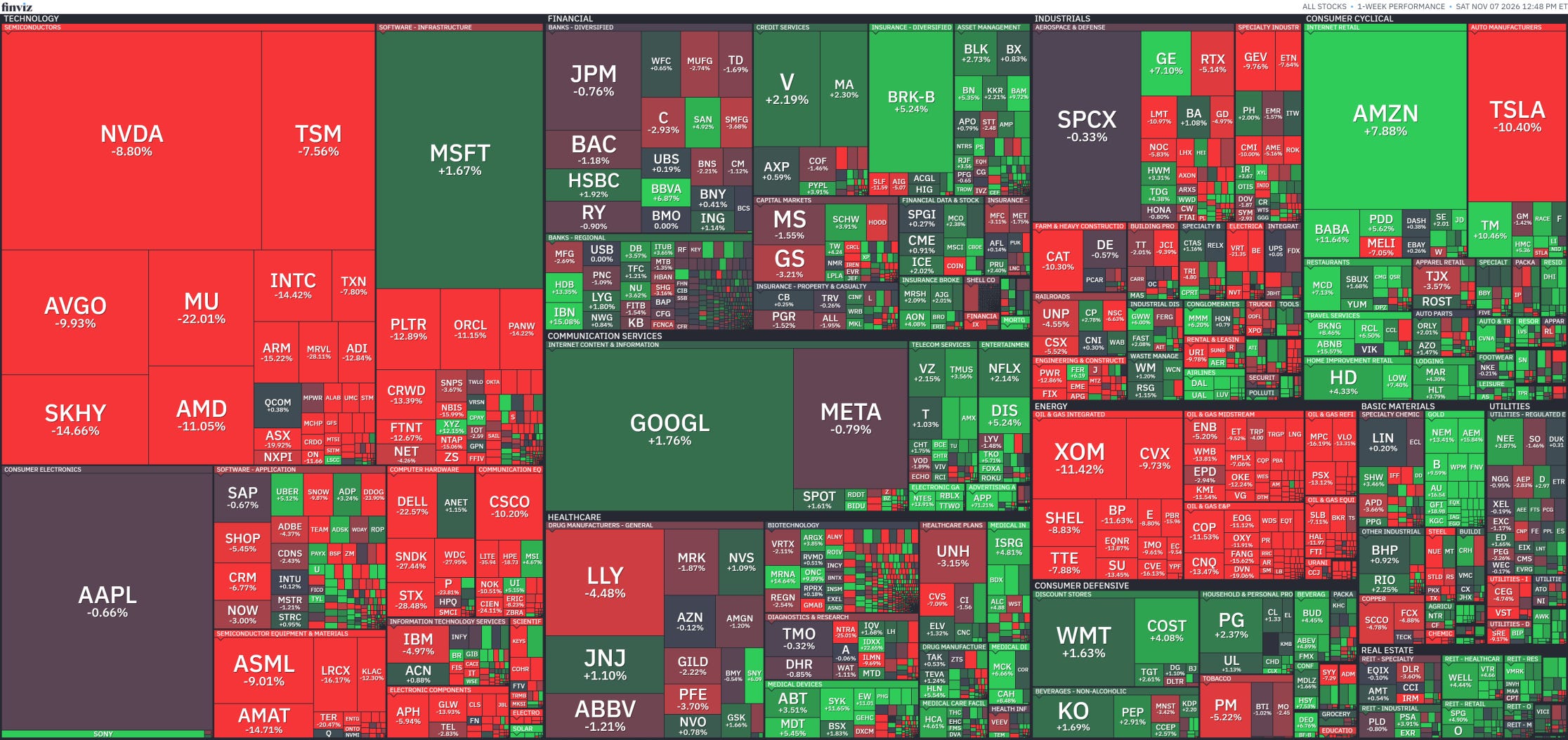
I took a whole week view as market participants should have had a good idea of the election outcome at the start of the week as polls and prediction markets were largely aligned.
The Thursday shock, with the AI trade at the epicenter, was likely due to de-leveraging by hedge funds triggered by re-weighting macro assumptions to lower growth of the data center buildout due to the seismic shift in the political and regulatory landscape at the state level.
For the week, for our retirement portfolio, the Schwab US Dividend Equity ETF (SCHD) was flat while the cap-weighted Vanguard Total World Stock ETF (VT) was down 2.7%. The international diversification benefit of VT didn’t help much (S&P 500 down 2.9%) due to the cap-weighting construction of the portfolio. The big market cap non-US companies are also tech-focused (e.g. SK Hynix, TSMC, ASML, etc.).
Other asset classes fared better. Gold was up ~5%, global real estate was up ~3.5%, and bonds were up 0.5-1.5%, depending on maturity.
The good news is the forced selling slowed down on Friday.
The bad news is that valuations are still historically high, corporate free cash flow remains encumbered by multi-year spending commitments, there are mega-IPO’s in the pipeline poised to add supply to the market, financing costs are high and rising, and margin debt is still excessive.
Revisiting Retirement Money Management Principles
When market uncertainty is high and I’m scratching my head, it helps me to revisit the principles that I’ve repeated often in my writing. I don’t mind repeating important things since they are easy to forget. And writing them down repeatedly helps me remember them. So here we go again (skip to the next section if you don’t need a refresher)…
The purpose of a retirement investment portfolio is to provide for a retiree’s family’s planned spending, expected and unexpected, not covered by other sources of income, over the course of one’s life.
A secondary purpose is to provide for legacy goals and to provide peace of mind.
The pursuit of these purposes must be carefully executed as a retiree does not have ready income to replenish the portfolio in the event of permanent capital loss.
To execute:
1. Start with your spending plan and identify non-portfolio sources of income. It should be an expression of a range of scenarios of how you might want to live your life. Include your spouse and children in these discussions.
2. Make it flexible.
3. Identify what your base level spending will likely be (housing, transportation, health care, taxes, food, insurance, etc.). Build in inflation assumptions.
4. Identify what your ideal spending would be (add the “nice to haves” on top of the “need to haves”). Dream big. Be careful not to double count (e.g. you can probably aspire to be a world traveler or buy and spend time at a vacation home on a lake, but you probably won’t have time to do both).
5. Iterate on the latter until the numbers work.
I prefer to construct our portfolio to serve our spending plan. Others may construct their spending plan as a byproduct of their portfolio, such as by withdrawing a certain percentage of their portfolio balance each year and spending that. To me, that is the tail wagging the dog. But your approach should match your mindset.
The foundation of our portfolio construction is having 4-6 years of spending needs invested conservatively (money market funds, T-bills, short-term investment grade bonds). I boosted my conservative allocation from 5 years to 5 ½ years in August after Fed Chair Kevin Warsh’s Jackson Hole speech when it became clear monetary policy would become a headwind to markets.
The income generated by both the conservative portfolio and the growth portion of the portfolio adds another six months of spending cash each year. So, we are theoretically at a maximally conservative asset allocation vs. our policy.
The growth portfolio, outside of low-cost basis legacy positions, is constructed about half in the cap-weighted Vanguard Total World Stock ETF (VT) and half in the 100-stock Schwab US Dividend Equity ETF.
I am uncomfortable allocating 100% to the cap-weighted VT due to the top heaviness of its top ten stocks (~22% of the portfolio), ALL of which are driven by the AI factor. Five of the next ten (an additional 3.7% of the portfolio) are AI-related. Quite the concentration for a 10,000-stock fund!
SCHD, with almost no exposure to the AI trade and low exposure to financials, diversifies both VT and our low-basis legacy holdings while remaining invested in very high-quality stocks.
Another principle I follow is to minimize investment expenses. Both VT and SCHD sport a low 0.06% expense ratio. In my planning, I budget for an annual total return of 7.5% from our growth portfolio, after fees. I’d have to budget close to 8.0% if we used actively managed funds, and I’m not smart enough to find such funds that will outperform index funds consistently.
Put another way, investment expenses are no different than a wealth tax, which even California voters rejected on Tuesday. And they compound over time. Every time the tax is assessed that is money out of our portfolio that will not generate future returns. As our portfolio grows, the drag would grow.
If you have complex needs beyond your DIY abilities, however, paying an advisor is the way to go. But find an advisor who earns their fee. This is distinct from paying high investment expenses embedded in specific investments.
Managing a simple retirement portfolio does not have to be complex. But if you own a business, have a special needs child, have an estate tax problem, or are otherwise in over your head, paying an expert can keep you from making even more costly mistakes. I plan to do just that when we get deeper into our golden years as insurance against cognitive decline.
Thoughts on Investing After the Election Results
I tend to under-react to things. Especially politics.
Politics sucks a lot of air out of the room as the press is fixated on it. It can easily suck my attention away from reality if I’m not careful.
If I’m a hedge fund PM with a daily or weekly P&L and my clients expect me to never lose money, I would think differently. On Thursday, they did, and de-leveraged into the uncertainty and spike in volatility.
I’m not a hedge fund PM and never could be. But I do pay attention to new information as it can change the fundamentals that underpin investment decisions.
My conclusion from my reading of the election tea leaves leans marginally positive short-term with an increased probability of permanent stagflation long-term.
Investment changes? Simply letting our equity allocation drift lower with the market rather than rebalancing.
What is new?
Congress has shifted from Republican control to Democrat control. Very little got done under the Republicans, so they were fired. Very little is likely to be done under the Democrats unless the Senate opts to eliminate the filibuster that currently requires 60 votes to move legislation forward. If they eliminate the filibuster, President Trump will likely be less inclined to make deals and more inclined to veto. My base case is that the change in control will be a non-investment factor with a higher probability of hiccups around fears of government shutdowns.
The angry electorate put Democrats in charge of states that used to be solidly red such as Texas, Ohio, and Kansas. Even the Florida governor’s race was very close. Texas and Ohio had been active in permitting new data center construction. This will get tougher. Democrat governors will also preside over potential redistricting, making 2028 elections even tougher for Republicans. This increases the odds of Democrats controlling both Congress and the White House beginning in 2029.
What is not new
Of the past ten bi-annual elections, Democrats have “won” six times and Republicans have won four times. According to exit polls, the economy or inflation was a top two issue in all these elections. If the party in power presided over challenging conditions, they lost. Despite strong aggregate economic indicators, consumer confidence has been low as real wages have consistently declined. Data center construction and the Iran war have been big contributors to continued inflation pressure, and thus Republicans likely never had a chance.
Cities have been and likely will continue to be under the control of Democrat mayors. The largest city with a Republican mayor is Dallas (ninth largest in the US), and he was a Democrat until he switched parties in 2023 (he was elected as a Democrat). After Dallas, the only US city with a major sports franchise with a Republican mayor is Oklahoma City. Local politics, which drives day-to-day life, is remarkably stable with respect to party control.
What is in question
Was this a permanent shift to the left due to a demographic change (liberal Californians relocating to Texas, for example, like they did before to Colorado which is now solidly blue or younger voters who lean left taking share) or a normal pendulum swing with the mood of the voters?
How left is left? I never heard of the Democratic Socialists of America, or the DSA, up until a couple of years ago and now DSA politicians seem to be everywhere.
Investment Questions
The big short-term question is how to think about and model AI spending. More moderate spending might be a good thing for markets. Why?
1. Near-term free cash flow, the numerator of valuation models, would improve over a forecast period.
2. If competition for scarce resources used to build data centers is indeed a big contributor to inflation, inflation expectations and cost of capital for all companies (the denominator of valuation models), would come down.
3. Slower growth of AI would give users a chance to breathe and implement AI into workflows. Rapid model release cadence makes it tough to commit to an adoption strategy. Broader AI implementation should both increase profit margins and lower prices. Both are positive for valuation.
4. Slower growth will reduce balance sheet strain, perhaps further lowering cost of capital. Good for valuations.
5. The hyper growth assumed in models was being heavily discounted anyways as investors were uncertain how it would translate into profits, if at all.
At the same time, I don’t think Democrat governors have the luxury of being draconian with respect to disallowing data center construction. Democrats have big spending agendas. Big spending agendas require tax revenue. Data centers throw off a lot of tax revenue. Big tax increases will get them fired. Governors depend on growth in the tax base as much as any other public executive managing a budget. Sensible deals will likely be made.
The big intermediate-term question is “did politicians get the message”? Republicans did not when they won in 2024. Will both parties understand that voters have a distaste for inflation?
Unfortunately, politicians of all stripes have a natural inclination to promote inflationary policy. And the back-breaking national debt compels inflating it away. Still, one can hope the message will be received, and gas won’t be thrown on the fire.
I’m still modeling 2.5% for long-term inflation in our spending plan…in-line with market-implied inflation assumptions. It no longer feels conservative, though.
The big long-term questions are “has the United States permanently shifted to the left?”, “Is the US no longer exceptional?”, and “Will US economic growth become similar to Europe and Canada?”
I think socially the US has been moving left for generations. Economically, it tends to shift periodically. To remain exceptional, the country needs to be a place where everyone has a legitimate chance to live their aspirational life on their own terms in exchange for putting in the effort. Today, especially among many young people, that trade doesn’t seem to be possible.
The US Declaration of Independence states in its preamble, “We hold these truths to be self-evident, that all men are created equal, that they are endowed by their Creator with certain unalienable Rights, that among these are Life, Liberty and the pursuit of Happiness.”
I will happily support any candidate of any party for any office that will respect these unalienable Rights.
Finally, I want to leave on a high note. Enjoy a few more fall images from Cape Breton Island!



Have a great week!
Discussion about this post