Live Large

Published on 2026-07-26 on LinkedIn
Last week I introduced the term, “memory dividend”, and I didn’t credit the guy who coined the phrase, Bill Perkins. Bill wrote the excellent personal finance book titled “Die With Zero”.
I read the book during my retirement planning and discussed the book with my friend this week, so I’ll share a couple of thoughts about it now.
First, the words “Die With Zero” should not be taken literally. It is a mindset. A mindset that it difficult to adopt for people like me who have been saving their whole lives and think about risk all the time. I wish he would have titled it, “Live Large”, but that probably would have sold fewer copies.
It is not a dangerous concept for someone like me. I am not capable of being tipped toward reckless spending. If I hadn’t read the book, however, I would have been capable of being convinced that winning equals maximizing terminal net worth.
The book should not be read by the median American who already has a financial net worth that rounds to zero as he won’t be able to benefit by any of Bill’s insights.
I don’t mean to sound judgmental. There is no right or wrong way to live a life as long as it is aligned with your values…and hopefully your values are sound. If I keel over tomorrow, I’ll have no regrets, but I certainly over-saved!
Second, the theme of the book is your financial resources are least enjoyed when you are dead. Unleash your resources when you are alive. Thoughtfully.
Sounds simple, and it is. There are two concepts I remember.
First, if you have kids (and you like them and they are financially responsible), don’t wait until you are dead to let them enjoy their inheritance. That is no fun for you and it is a needs timing mismatch for them.
Chances are, if you are a responsible person yourself, not only will you die old (because you responsibly take care of yourself), but you will die with a lot of money (compounding effect). Therefore, if you go the traditional route and leave your kids your fortune in one lump sum, the following happens:
(1) They are probably old themselves.
(2) Because they are old and you taught them financial responsibility, they are probably retired or near retired themselves.
(3) They are going to get a pot of money when they least need it.
(4) They will have a tax problem if you leave them traditional IRA money as they will have to withdraw within ten years of you dying. A bigger portion of the assets you responsibly worked hard for will go to the US government for what I’m sure will be productive spending.
(5) Unless you are a ghost or a zombie, you will not be able to observe how your money will impact your kids (or a charity if you don’t have kids or you have rotten kids). If you are a zombie, you’ll be more interested in eating your kids than observing the impact.
Of course, you probably don’t want to put your own financial security at risk or deny your kids the chance to make it on their own. But if you find your financial resources ramping well beyond your ability to spend, give the advanced inheritance concept some thought.
Some ideas:
(1) Pick up all dinner tabs when your adult children join you.
(2) Get them started with a Roth IRA when they are in their low tax bracket years to allow it to compound into something substantial.
(3) Help them and their kids with college.
(4) Host an annual extended family vacation.
Second, good memories pay dividends. Sometimes it costs money to make memories. Often it doesn’t. But don’t forget about the value of memories that create mind value for years, if not decades. Skipping out on creating a great memory because you don’t want to see your brokerage balance decline has a real opportunity cost.
Bill also emphasizes the importance of planning for memory creation by cautioning that healthspan is largely fixed. Understand that working another year to increase your financial resources costs a year of creating memories.
Similarly, if you have a bucket list, analyze it for when in your life it makes the most sense to check off each item. Prioritize them (maybe on the financial cost for each unit of projected memory dividend?...I just went off the diving board into the nerdy end of the pool). And then figure out which item fits which season of your life.
For example:
· Backpack the Alps (50’s)
· Cycle the Allegheny Passage (60’s)
· USA cross-country road trip (70’s)
· Cruise time (80’s)
Work these into your financial projections and iterate until your life goals align with your financial resources.
The bottom line is if you are like me, you don’t want to die with anything close to zero. Having a financial buffer adds value to my life. I don’t want to be a burden to my kids. I don’t want to be a burden to the government. I don’t want the stress. But I do agree with the above concepts that stuck with me long enough to share.
I’m a map geek
When I was a kid, my favorite thing to do when I returned from a family vacation was to get out big drawing pads and create maps of where we had traveled, with road signs and landmarks. I would then use these maps as the base for a “world” inhabited by my Matchbox cars. I could draw all these maps from memory.
As I got older, my maps became more elaborate. I wouldn’t need a vacation. I’d simply use my annual Rand McNally Road Atlas that I would inevitably receive as a Christmas gift as a guide.
Over the past decade or more, I have geeked out on Google Maps and Google Earth. I use them both to scout photo locations and plan shoots while considering the angle and direction of sunlight (and sometimes moonlight). I also use them to virtually travel all around the world while saving places I find that I might want to visit to lists (create in Google Maps). I have lists titled “Someday/maybe” (h/t David Allen), “Photo locations”, “Waterfalls”, “Hikes”, “Restaurants”, etc. with locations all over the world. I figure I can open Google Maps wherever I may be and see what items on my list are nearby.
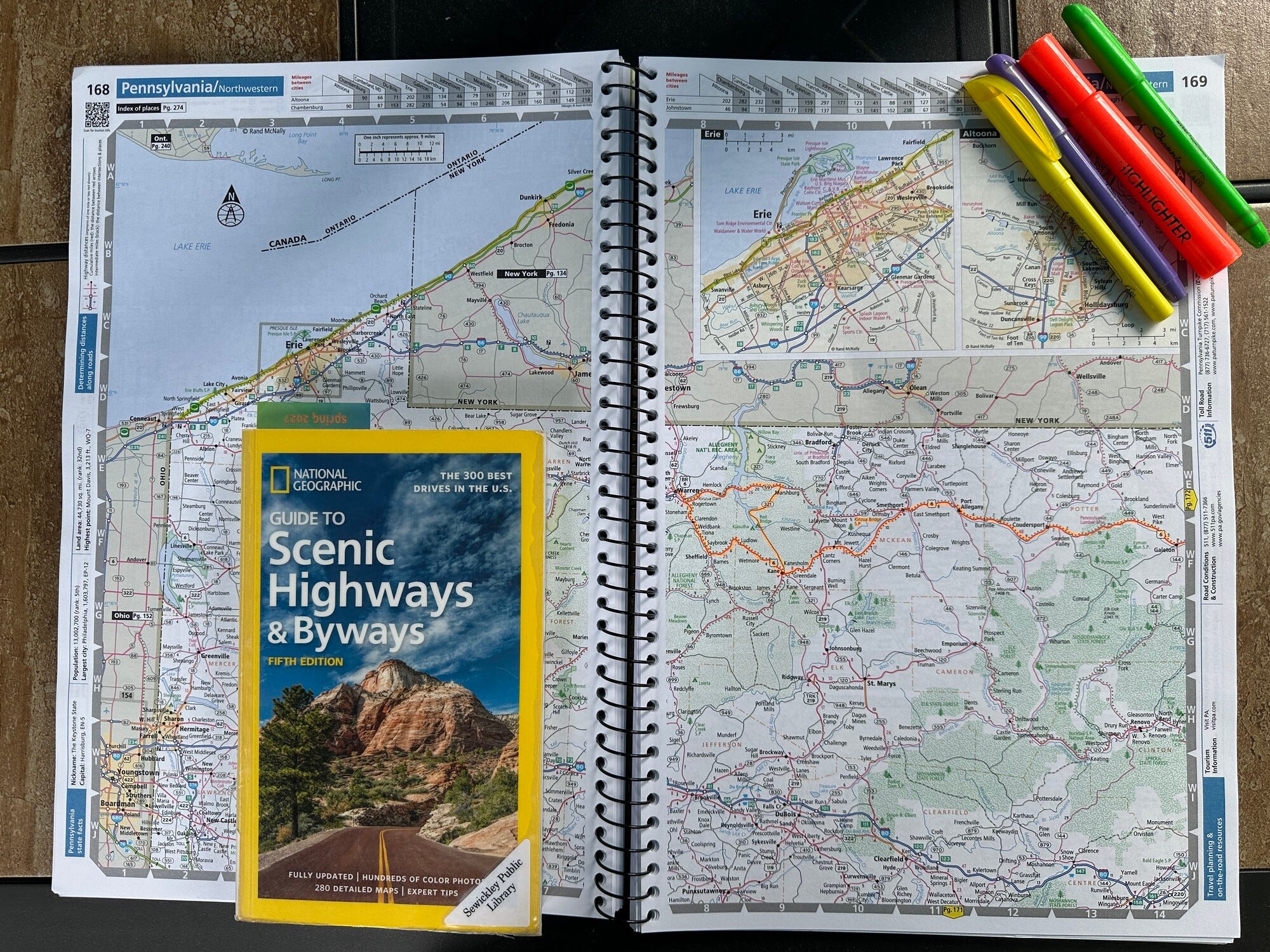
This past week, I went back to analog. I borrowed the National Geographic “Guide to Scenic Highways & Byways: The 300 Best Drives in the U.S.” from my local library. I then ordered the 2027 Rand McNally Road Atlas (the giant one!). Excitedly, I’ve begun highlighting the routes recommended by the book on the maps. Orange for fall (my favorite travel and photography season), green for summer (northern states), yellow for spring (southern states), and purple for winter (Florida).
What is my point? There is none. I’m retired and I can do stupid stuff like that. Retirement is a time to be a kid again and spend time on the weird things you like to do.
Back Deck Investing
Week two of earnings season is in the books. Results remained good, but you’d never know it if you are invested in the S&P 500, which has generated a -2% total return over the past two weeks.
The S&P 500 is a market cap-weighted index, and with a 50% weighting to tech (if one were to mentally move Alphabet, Amazon, Meta, and Tesla to the tech sector), it is not diversified in a traditional sense. Currently, it is a bet on the financial success of artificial intelligence.
Within technology, leadership bounces day-to-day between the AI spenders (the hyperscalers such as Microsoft, Alphabet, Amazon, Tesla, and Meta), the beneficiaries of the spending (semiconductor, memory, and hardware industries), and the potentially disrupted software industry. So, there is some diversification within the tech sector.
Beyond tech, AI still dominates the narrative, stretching all the way to electric utilities (they power the data centers), their suppliers such as GE Vernova (the utes need to add capacity), the energy sector (when capacity is built, the utes will need energy molecules to feed the GE Vernova turbines), and industrials (all sorts of equipment needed to build and run data centers and the electric grid).
The marginal buyer or seller of a stock that is driven by the AI narrative will either have a long term view of the size, timing, and financial implications of the AI buildout or more likely is betting on how other investors’ narratives are evolving. Why? Not even the companies spending the hundreds of billions of dollars have a clue what the ultimate returns on that spending will be.
The narrative today is clearly one of uncertainty that is overlapping with the return of war-driven higher oil prices. The latter drives inflation which drives the cost of money which drives the price an investor demands for uncertainty higher.
This is ultimately fine for an institutional investor or an individual investor who is still contributing to their stash. And for a young investor, drawdowns are good as more shares can be purchased for each dollar of investment.
A traditional portfolio has two goals: grow as fast as possible and avoid permanent losses of capital. A 100% allocation to an S&P 500 Index Fund is usually the right approach for a younger investor.
For a geezer retiree like me, volatility and drawdowns suck.
A retirement portfolio also has two goals: fund the owner’s desired lifestyle and goals while at least keeping up with inflation.
The construction of that portfolio will be very different from the generic allocations you hear about on TV, read online, etc. The only benchmark is meeting your needs.
For me, that involves:
(1) the cash portfolio for near term expense funding (T-Bills for the next three years, a 0-3 month T-Bill ETF for a contingency fund, a little bit in a money market fund for timing mismatches, and a short-term corporate bond fund in a traditional IRA for expenses for years four and five).
(2) The growth portfolio to replenish the cash portfolio. Beyond legacy low basis stocks in the taxable account, I’ve gone with the 10,000 stock Vanguard Total World Stock Index ETF (ticker: VT) and the 100 stock (Schwab US Dividend Equity ETF (ticker: SCHD) as my core holdings.
VT is barely more diversified than the S&P 500 and highly correlated (also fell 2% over the past two weeks) as it too is market cap weighted. SCHD is a different beast. It was up 3%. My theory is that in the current environment investors prefer companies that aren’t going to surprise them with big spending plans with uncertain payoffs. Those would be companies that are constrained with material dividend policies. These companies could ultimately also be beneficiaries of AI. Especially if the economics turn out to be challenging for the AI companies themselves. In that scenario, AI becomes commoditized (like the internet, electricity, the automobile, etc.) and AI users capture the bulk of the economics.
Big earnings week coming up with Microsoft, Meta, Apple, and Amazon.
Back to coloring on my maps.
Have a great week!
Steve
Discussion about this post