Four-Month Retirement Check-In

Published on 2026-10-18 on LinkedIn
I asked ChatGPT to interview me about my first four months of retirement. If you want to learn about what you really think about something, have your favorite AI interview you!
The overall takeaway from the interview:
I thought the first day of retirement would feel like Independence Day. Instead, it was disorienting. Four months later, I’m sleeping better, spending more time with the people I love, and figuring out what deserves my attention. I’m also learning that retiring from work is easier than retiring from the habits that made work so rewarding.
And the full interview:
Q: You’re four months into retirement. What’s surprised you most?
Steve: How fast the days go by. There’s always so much to do and so little time to do it.
When I was working, I think I deferred the to-do list from the non-employment areas of my life. I didn’t think much about those things because work took up so much of my attention. Now I’m doing things that may be less important to the economy but are more important to me.
I’m sleeping more. I get up when I wake up, and I’m regularly getting seven to eight hours of sleep. My sleep quality was lousy during the initial disorientation phase, but that’s improved.
I’m exercising more regularly, although not enough. I take Spencer to work and pick him up every day, which is 40 minutes of commuting. I spend more time listening to MJ, and we go on more dates. She’d say not enough, and she’d be right. I’ll get there.
I’m reading more, probably too much. I need to keep shifting from reading to doing.
October has also been a great month for sports. My Cleveland teams are finally all competitive with the Guardians still in the baseball postseason mix, and the Buckeyes are always good. I won’t say anything about the 3-2 Browns as I don’t want to jinx them.
But I’m also spending too much time working on investing. I enjoy it, and I’m particularly interested in exploring how AI might help one person…me…run an institutional-quality personal investment operation. The jury is still out.
The problem is that doing it right, even with AI, takes serious time. That time crowds out other things. I need to figure out whether investing is a genuine passion I want to pursue or a habit I’m carrying over from my career.
I’m hoping a photography workshop in Nova Scotia next week will help. MJ bought me a three-day, one-on-one landscape photography workshop with Gavin Hardcastle, the YouTube photographer who hosts the @fototripper channel. I’ll spend most of this week on Cape Breton Island in Nova Scotia capturing the colorful scenes of my favorite season.
That’s the kind of thing I want more of in retirement.
Q: You could have slept more, exercised, read, gone on dates, and pursued photography while you were still working. Why did you need to retire to do those things?
Steve: I could have lived a more balanced life while working. Nobody told me I couldn’t work less. That was my choice, and I’m fine with it.
Two things drove that choice. First, I loved my career and the people I worked with. Second, I always wanted to be the best at what I did, and that took time.
The drive to be the best made a balanced life difficult. Loving the work gave me the energy to put in the time.
I’m still reinventing myself. It’s not as easy as I thought to turn off the old Steve and turn on the new Steve.
Q: What do you mean by reinventing yourself? Have you lost your identity now that you’re no longer an investment analyst?
Steve: I’ve definitely lost my work identity. Nobody comes to me with the questions they used to ask. I don’t know whether they don’t want to bother me or whether I’ve simply become out of sight and out of mind.
I can see how that could negatively affect someone whose identity was tied primarily to their profession. It doesn’t bother me much as I was always most interested in my own opinion of myself rather than others’. Fortunately, I have a personality that requires little external recognition.
If you’re contemplating retirement and you love getting accolades, you’d better either work on that or simply never retire.
I explained in a prior article that I still have the same roles I had before retirement, but with a big change in how I allocate my time. Those roles include husband, father, son, amateur photographer, community contributor, and personal CFO, among others. The analyst role no longer gets the enormous share of my time.
I also defined my ideal end state, or purpose, in another edition. Having that written down helps me decide which projects and daily activities to pursue and what to say no to.
What I miss most about work sounds clichéd, but it’s the banter with my colleagues. They made me better, and they were fun to be around. I consider them friends, but we don’t talk nearly as much as we used to.
Since they are as busy as I was, I’ll either need to find new friends or patiently wait for them to join me on my back deck—or their own!
Q: You expected retirement to feel liberating. Instead, you felt disoriented. What happened?
Steve: I thought the first day of retirement would be the best day. I expected some kind of dramatic Independence Day feeling.
Instead, it was disorienting. Four months later, today is the best day so far, and tomorrow should be even better.
Like anything else, you get better at something with experience. Life is about learning and adapting. This is especially true in retirement because you’re the one in charge of structuring your years, months, weeks, and days.
I think the disorientation is natural whenever there’s a big life change. You move to a new city, take a new job, have a kid, or retire. You just have to work your way through it.
The most important thing to know is that it gets better. The worst thing you can do is assume you’ve made a mistake and instinctively reverse course.
Writing this weekly newsletter has helped accelerate the process, I think. Getting my thoughts out of my head has been as helpful as I expected when I started writing.
Q: Let’s talk about money. Even when the numbers work on paper, living without a paycheck can be psychologically difficult. How has that transition gone?
Steve: The system I discussed in earlier articles is working so far. The best part has been the cash-management approach we use to fund our lifestyle.
Decumulation is psychologically tough for a saver. Having securities mature at the end of every month in line with our projected spending has been a helpful psychological hack. I don’t need to sell anything. I simply take the proceeds and transfer them to our checking account.
Anything left over from the prior month goes into a reserve account for lumpy expenses, invested in a money market fund. If I’m short, and fortunately I haven’t been so far, I’d just move funds from the reserve account to the checking account.
The growth portion of the portfolio is invested simply in two ETFs, low basis legacy positions, and a smattering of individual stocks to keep me engaged. Returns will be used to replenish the cash-management bucket, which now holds more than five years of the lifestyle spending not covered by other sources of income.
I’m supposed to look for rebalancing opportunities only every 12 months. My weakness is that I check the portfolio several times a day, even though I rarely do anything. It’s a force of habit that I hope to resolve over time.
I have automated the search for new investments via AI agents that work according to my instructions. But I do have to review the agents’ work and dig deeper when an opportunity arises, and that also takes time. I’ll evaluate it after a year to see if the sampling of individual stocks added value and then I’ll either expand the operation or abandon it to recapture my time. Returns are good now, but four months is an inadequate test.
I’m not stressing about the market. It’s been volatile, but our overall portfolio balance is higher than when I retired.
The plan is to reduce the cash bucket after a material, unwarranted market decline and increase it if the opposite happens. My discipline hasn’t been put to a real-world test yet, but I’m fairly unemotional about investing, so I have confidence in my ability to execute the approach.
My advice to DIY investors is simple: Know yourself and develop a system that aligns with your skills, interest, and most importantly, that will survive your own behavioral fallibilities.
Q: How has retirement affected your relationship with MJ?
Steve: When I first retired, I worried MJ would get tired of having me around all the time. I’m not the easiest person to digest in big doses unless you’re addicted to Dad jokes.
I do sense that she appreciates having more of my attention, even though it doesn’t always seem that way because of my natural introversion.
It’s been fun for me. I appreciate her more than ever, particularly given how some of our roles now overlap. As I’ve said before, she’s my number one advisor, and it isn’t even close.
I’ve tried to adapt my retirement vision to our family realities. I think we’re both willing to change that vision as our circumstances change.
We’re a couple with shared interests, but we’re also individuals with individual interests. Sometimes it’s challenging to get the balance right, but we do our best.
The great thing is that if I need to do things differently to make our relationship stronger, I now have more time and mental space to work on it.
Q: You have much more control over your calendar now. Are you learning to enjoy that freedom, or do you still feel compelled to be productive?
Steve: At month four, and age 58, there’s still a tension around productivity.
I feel guilty watching a ballgame sometimes. Thursday’s ALCS started at 1 p.m., when I should have been preparing for my Nova Scotia trip!
I feel better about doing something outside my written purpose if I can classify it as recovery. I feel bad if I’ve still got gas in the tank.
I need to get better at being a human being when I’m not a human doing.
I’m not particularly concerned about it. I know I’ll settle into something that works for me. Again, retirement gives me the mental space to figure it all out.
Q: What would you tell someone who’s financially able to retire early but still enjoys their career? How do they know when it’s time?
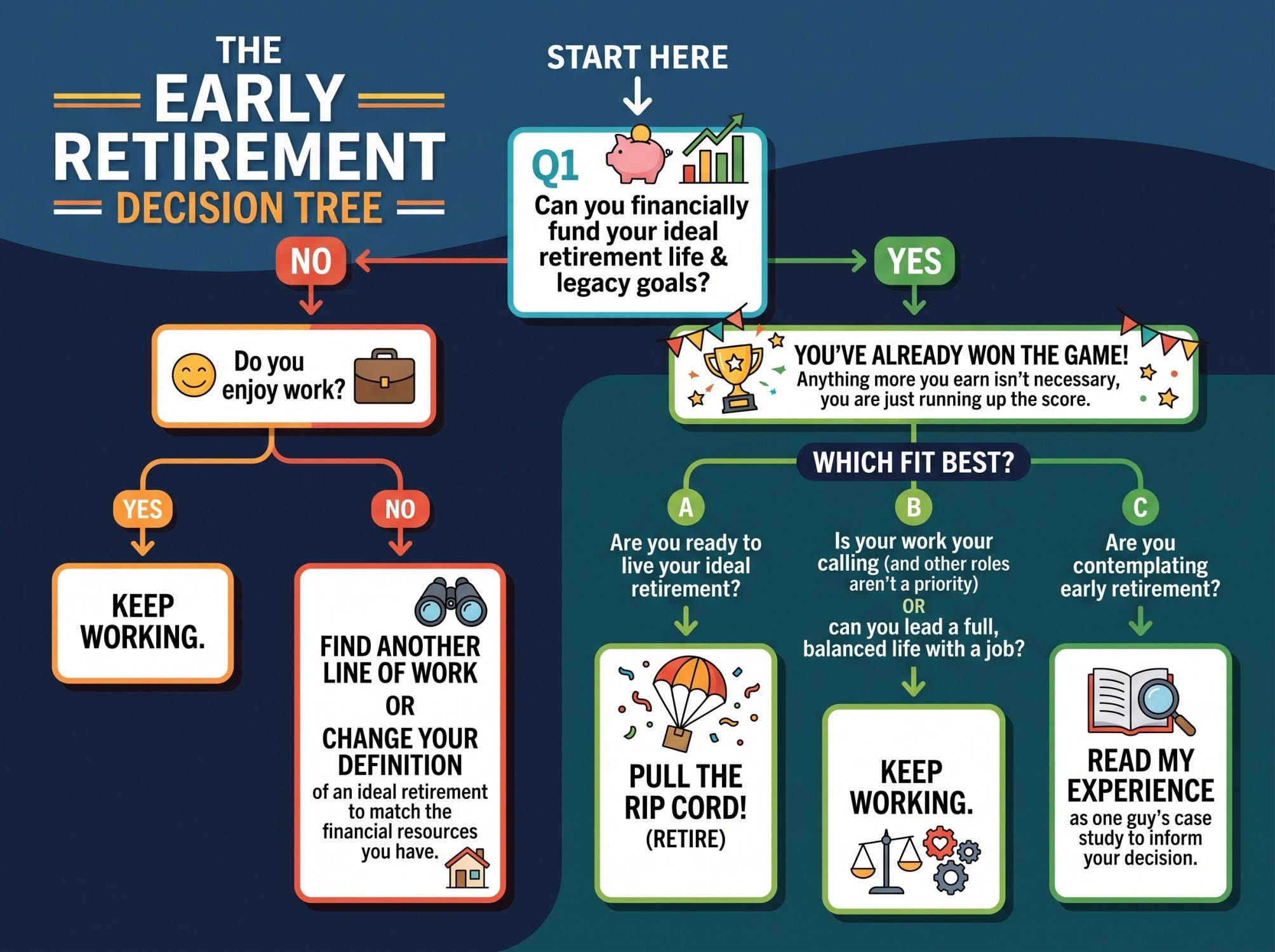
Steve: If you aren’t financially able to fund your ideal retirement life and you enjoy work, keep working.
If you’re contemplating early retirement and you are financially able, read my experience as one guy’s case study to inform your decision.
If your work is your calling and your other roles still aren’t a priority, keep working. If you’re someone who can lead a full and balanced life with a job, keep working.
But know that if you have the financial resources to fund your ideal life and your legacy goals, anything more you earn isn’t necessary. You’ve already won the game and now you are just running up the score.
If you can’t fund your ideal retirement life and you don’t enjoy working, either find another line of work or change your definition of an ideal retirement to match the financial resources you have.
If you can fund your ideal retirement life and you’re ready to live it, pull the rip cord!
The great thing to remember is that you can always change your lifestyle or employment situation if retirement isn’t what you thought it would be. Just give it time before making those changes.
Q: What advice would you give yourself at age 53, five years before retirement?
Steve: I’d tell 53-year-old Steve:
“You have a good plan. Trust it and trust yourself to adapt should circumstances change. Invest in your non-work relationships, as they become even more important when you retire. Declutter and simplify your life in advance if you can, so you can hit the ground running.
You will at first feel disoriented rather than liberated. Don’t feel the need to rush into a new identity. Take time to breathe and just be.”
Q: Finally, what would success look like one year into retirement?
Steve: I’ve done the contemplative work on what’s important, so success in one year will mean living more consistently, day to day, with my purpose.
If I can do that, everything else should take care of itself, from wealth to health to relationships.
I don’t have everything figured out, but I’m grateful I’m allowing myself to try.
And I have no regrets.
Have a great week!
Discussion about this post