Don’t Fight Yourself by Not Fighting the Fed

Published on 2026-09-20 on LinkedIn
This may sound like upside down inverse double negative investment advice. It is not. I am not a financial advisor; I am explaining how I think about retirement investing and giving advice to myself. Take what is useful and leave the rest.
Better yet, print this out and take it to your advisor and say, “Hey! Look what I found on the internet. What do you think?”. They love that!
August 28 was a big day for me. Of course, it was our wedding anniversary. It was also the day of Fed Chair Kevin Warsh’s first Jackson Hole speech.
Fortunately, unlike FOMC press conferences, the speech was delivered in the morning, and anniversary festivities didn’t start until after noon. And no stupid questions were allowed, because no questions were allowed.
I found it refreshing that Chair Warsh laid out principles for managing the often-conflicting goals of low inflation and full employment (aka, the “dual mandate”) instead of drawing a map of likely future policy. Investors still have to follow the incoming data and make their own decisions rather than wait for the Federal Reserve to tell them what will happen. That approach also mutes the circular-reference problem in which the Fed follows the markets while the markets follow the Fed.
My reading of the speech was that Chair Warsh sees what the rest of us are experiencing: employment is holding up, but inflation is too high and has been for too long.
That made it plausible that the Fed would remain on a tightening path, meaning higher short-term interest rates. On Wednesday in a 12-0 vote, the FOMC announced a 25-basis-point hike, taking its target range for the federal funds rate from 3.75% to 4.00%, despite urging from the White House for cuts ahead of the November midterm elections.
Since the August 28 speech through this writing, the market cap-weighted S&P 500 and Vanguard Total World Stock ETF (VT) had a total return of about -1%. The Russell 2000 Index and Schwab U.S. Dividend Equity ETF (SCHD) were each down about 3%. Daily chop has been high.
What does a new FOMC hiking cycle mean for a retiree’s investment portfolio? “Don’t Fight the Fed,” a rule of thumb coined by Martin Zweig in his 1986 book Winning on Wall Street, is useful. What Zweig concluded is that asset prices tend to move lower during a rising interest rate cycle and higher during a falling interest rate cycle.
However, I still place the rate cycle in a broader mosaic of information rather than treat it as a stand-alone answer.
First, let’s start with the objective of a retirement investment portfolio. Like the Fed, retirees have a dual mandate:
1. Fund retirement spending and legacy goals that are not covered by other income sources; and
2. Avoid a permanent loss of capital that causes the first objective to fail.
Why a higher Fed Funds rate helps fund retirement spending
When I see rising interest rates, the first question I ask myself is, “Why?”
This cycle appears to be driven by persistently high inflation above the Fed’s 2% target. The longer inflation stays above target, the greater the chance that long-term inflation expectations will rise. If that happens, inflation can become stickier: consumers may accelerate purchases to beat future price increases, while workers may demand higher wages. That combination could produce a classic wage-price spiral. It is difficult to unwind once it becomes embedded.
To manage inflation expectations, the Fed needs to re-establish credibility that it will try to control inflation.
In my view, increasing the Fed Funds now is safer than doing nothing.
Doing nothing could signal to markets, businesses, and consumers that higher rates are unlikely. That would encourage additional borrowing and more leverage on company and household balance sheets on top of already high leverage.
Raising rates, and signaling that the Fed will raise them again if necessary, discourages leverage. Borrowing costs more today, and rates may keep rising, making incremental borrowing extra risky. Some spending and investment opportunities will no longer clear the required return hurdle.
At the same time, people and businesses have more incentive to save as safe cash yields rise. That would further reduce aggregate demand.
Taken together, these effects should reduce service, goods, and asset-price inflation relative to doing nothing.
For a retiree with a well-constructed portfolio, that can be good news even when the pundits are mad and portfolio values are under pressure. Here is why:
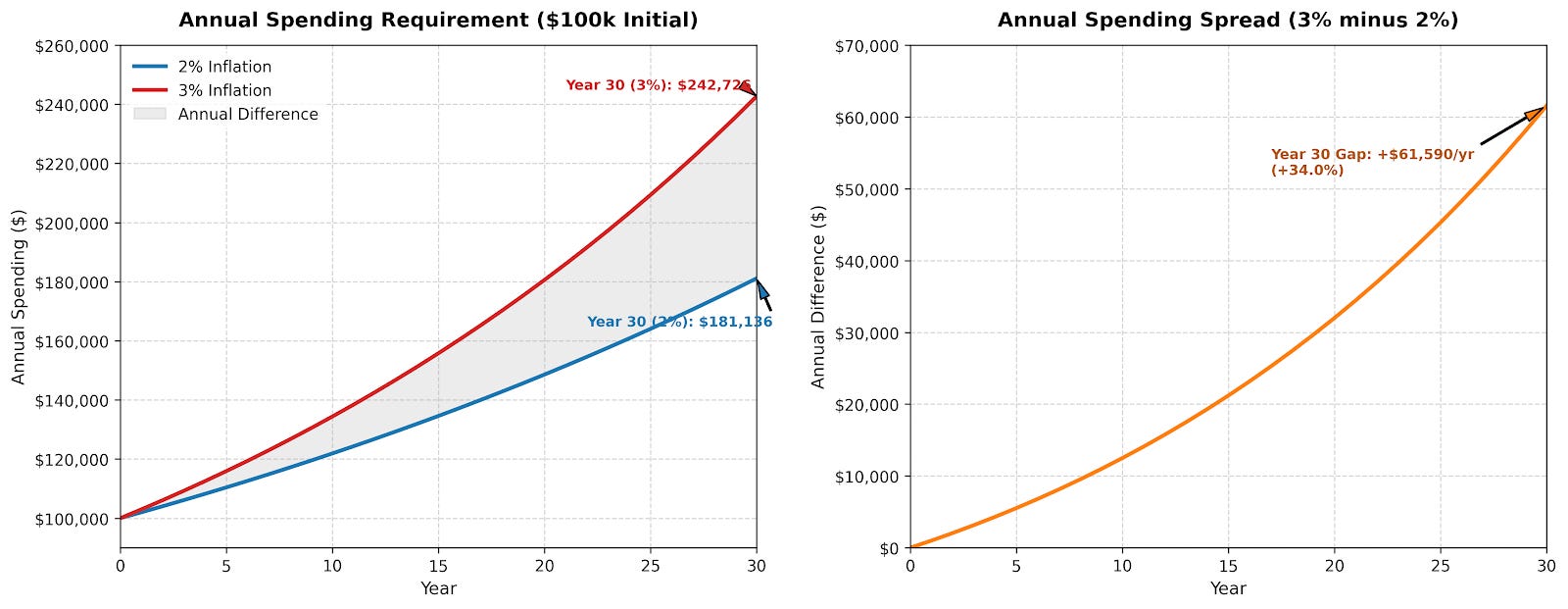
1. Inflation is the biggest uncontrollable variable that can break a retirement plan. Lower is better. Inflation compounds over time. Assuming a $100,000 starting spending amount and 30 annual spending payments, the difference between 2% and 3% annual inflation is roughly $700,734 in cumulative nominal spending.
2. Cash and short-duration fixed-income assets should be a cornerstone of many retirement portfolios, covering multiple years of projected spending. If you hold five years of spending in cash investments, or $500,000 under the assumption above, a 0.25-percentage-point increase in yield would produce $1,250 of additional pretax interest income each year.
If you spend $100,000 per year, lower inflation reduces your spending requirement relative to what it otherwise would have been. The extra $1,250 in your pocket also increases your spending capacity by 1.25%. So even if higher rates merely keep inflation from rising, the cash reserve itself can lower your effective personal inflation rate by 1.25 percentage points for EACH 25 basis point rate hike, before taxes.
Why higher rates do not automatically mean permanent capital loss
Don’t higher interest rates lower current investment values?
All else equal, yes.
But higher rates also increase the expected return on new investments by roughly the increase in the risk-free rate, again all else equal. That assumes you own a high-quality, diversified portfolio of stocks and bonds whose long-term cash flows are not permanently impaired by an economic cycle. It also assumes you do not need to sell during a rate-driven market decline because your own financial house is in order.
If you have ample cash reserves to fund spending while earning a higher return, and if your growth portfolio is tilted toward well-managed, financially strong companies, you can give those assets time to recover from an initial decline. A market-cap-weighted index fund will naturally provide exposure to companies that benefit when weaker competitors struggle, assuming scale is an indicator of strength and resilience.
The problem is that all else is not equal
If only we could invest based on simple rules such as “Don’t fight the Fed”!
The “all else” is what makes retirement-portfolio values both exciting and scary.
An asset’s value is the perceived present value of the cash it can generate for the investor. That value depends on forecasts of future cash flows, the probability of different scenarios, and the discount rate applied to each forecast.
Future cash flows are what investments generate and can return to investors, such as dividends for stocks or interest payments for cash and bonds. An investor can project the size of cash flows for one or more scenarios. A simple approach is a bear case, base case, and bull case. Stocks can produce a wide range of outcomes based on the success of the underlying companies. Bonds are easier to forecast as cash flows are contractual with the key unknowns being default rates (the borrower can’t pay you back) and reinvestment rates (if you don’t need to spend the money, what will the rate of interest be to put it back to work after maturity?). Cash flows from both stocks and bonds are heavily influenced by economic growth and government and regulatory policy where the underlying entity operates.
The probabilities of each scenario should add to 100%. A bearish investor will tend to come up with gloomier scenarios and weight the probabilities toward the gloomiest. A bullish investor will do the opposite. I’ll get into this a little more below.
The discount rate includes a risk-free rate, such as U.S. Treasury yields, plus risk premiums. The discount rate determines what a future cash flow is worth today. For stocks, that includes the risk free rate plus an “equity risk premium”; for bonds, it includes the risk free rate plus a credit spread. Academically, risk premiums and credit spreads reflect uncertainty about receiving projected cash flows. In practice, they also reflect supply and demand.
The mosaic of information I mentioned earlier is my attempt to assess the above valuation inputs without pretending that I can forecast them precisely.
What we know
We know current cash-flow generation. We know current interest rates, credit spreads, and dividend yields. We can reasonably estimate how much cash our portfolios may distribute over the next year.
What we think we know
We can use company guidance and sell-side analyst estimates to build a range for near-term corporate cash flows. We can look at interest-rate futures and FOMC projections for clues about government yields.
Present conditions are reasonably strong, so I have some confidence that my portfolio’s cash flow will be better next year than this year. That is a forecast, not a fact.
What we really do not know
We do not know how much cash companies and governments will generate over the intermediate and long term. This is where investors’ imaginations can make or break them. Beyond one year, companies usually stop providing detailed guidance. Some offer aspirational return or growth objectives; most offer narratives.
For developing a long-term cash flow forecast, stories dominate.
Bull markets are based on a predominance of stories that are more optimistic than yesterday’s stories. Bear markets are the inverse. In both cases, feedback loops develop with market trends driving the stories themselves.
Most stories about the future cannot be disproved in the present.
Few know what will happen, though some that are writing the stories such as Musk, Huang, Amodei, and Zuckerberg may have an inkling.
In government, the intermediate term is a long time in a democracy. Parties change, leaders change, and policy is volatile.
The long term is made up of questions we do not really know how to answer, along with questions we do not yet know to ask. Some of the questions on my mind today are:
· What will the Middle East conditions look like next year, and what will that mean for energy prices?
· Is U.S. fiscal policy sustainable given growing debt paying higher interest rates? What will ballooning debt mean for retirees’ Social Security and Medicare benefits, interest rates, and tax policy? What about the United Kingdom, Europe, China, and Japan?
· When will productivity growth from artificial intelligence overtake the financial and commodity-resource strains of the data-center buildout? Who will be the winners and losers?
Any of those questions can produce a wildly optimistic or pessimistic answer, or story.
The optimist could say that the Iranian regime will collapse under its own weight and give way to democracy and peace, producing global energy abundance. That peace dividend, combined with an AI-driven disinflationary boom and cures for chronic disease, would bring down interest rates and government health-care spending.
The pessimist could say the mullahs will outlast the U.S., with the U.S. administration caving in to a bad deal during a Hail Mary attempt to retain power. High energy prices would persist, a left-wing president would be elected, tax rates would go through the roof, and data centers would be regulated into oblivion.
The dispassionate investor would not become wedded to one scenario. Instead, that investor would model plausible scenarios and assign probabilities to each.
Even that is not enough, because every scenario is dynamic. As a scenario develops, markets and people adjust. Those adjustments create new scenarios and change the probabilities of the old ones.
The good thing is that most people—from presidents and boards to CEOs, CFOs, and you and me—want things to improve. We are also wired to work toward that outcome. Over time, those incentives may tilt the probability distribution toward better scenarios. This is not a law of finance; it is my cautiously optimistic interpretation of human behavior.
Bottom line
The point of this extra-nerdy and dangerously opinionated piece is not that every Fed tightening cycle is bad for retirees just because portfolio values tend to decline. It is that a tightening cycle can be manageable, and even helpful in some ways, for people close to or in retirement whose financial houses are in order.
Investing is hard. Stay humble, stay diversified, and keep a cash reserve so you can enjoy yourself instead of worrying about every market move.
Have a great week!
Discussion about this post