Convergence (of financial stomach punches)

You thought you were going to get a break from me this week! No such luck.
You are going to have to be my therapist as I talk myself off the ledge.
The past couple of weeks sometimes had me scratching my head about whether I should have worked one more year before hanging up the spreadsheets. I briefly lost my normally rational perspective of my situation.
What happened?
MJ’s car
I wrote about this a little last week.
MJ’s car unexpectedly reached the end of its life. A potential repair bill would have just been throwing money at a car that would been unsalvageable in the near term as the mechanic found body rust that would only get worse. Especially after driving on salty roads during Pennsylvania winter.
We replaced it with the same model, but newer. 168,000 miles down to 27,000. And the 27,000-miler has new tires, new brakes, a new transmission, a new torque converter, etc. It won’t need significant service for another 30,000 miles.
That’s the good news.
The bad news is cars aren’t free. I had a cash reserve set aside for a future car purchase but didn’t expect to drain it so soon.
My car
Not wanting my own 126,000-mile car to suffer a similar fate, I took it to the dealership for an “express” oil change and inspection last Saturday. The B-team was working at the dealership, told me everything was fine (including my tires which to me looked not so good), and as I drove off, the check engine light fired (the car had no symptoms of trouble before the oil change). I immediately returned to the dealership to have them look at it.
On Monday, another service advisor called to tell me he had good news and bad news. The check engine light was caused by something the B-team jostled, so it was fixed with no charge and nothing more to worry about. The bad news was the sub-frame that keeps the engine from falling on to the road was completely rusted and ready to fail. Oh, and my tires were almost completely bald going into winter.
Repair bill, including new tires? $4,500. I approved it as I was not going to buy two cars in one week (but I did enjoy my five days with the loaner!).
Mr. Market
Finally, there was this weekly Daniel Jones-esque market that we all experienced:
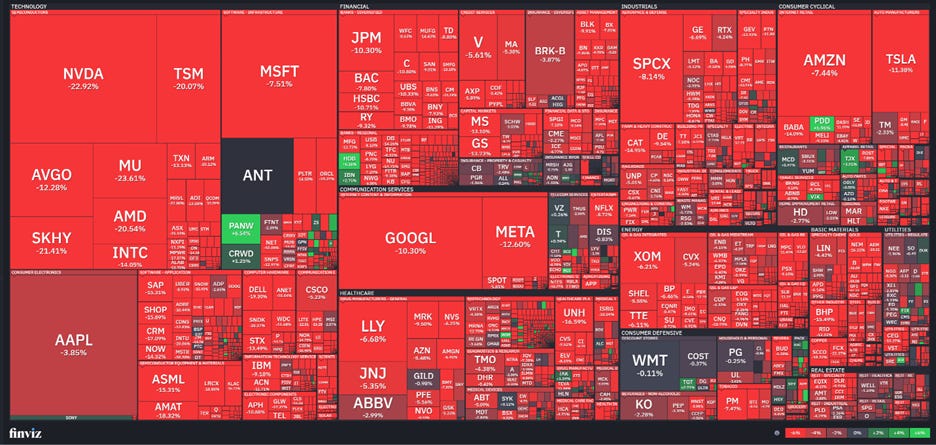
The color you see is blood red.
For our much-discussed growth portfolio (the portfolio that replenishes the cash portfolio which holds 4-6 years of planned spending not covered by other income sources):
· Vanguard Total World Stock ETF (VT): -7.2%
· Schwab U.S. Dividend Equity ETF (SCHD): -6.0%
The only solace is both beat the S&P 500, which was down 8.56% for the week. If I was still in my institutional investor seat, I’d be lauded for generating “alpha”. But relative return doesn’t pay the bills.
Part of the growth portfolio I don’t talk about are my low-basis legacy positions and my very small “FOMO” portfolio of individual stocks. This piece is about 25% of the overall growth portfolio. And this piece really took a beating.
The low-basis legacy positions primarily consist of:
· JPMorgan Chase (“JPM”): I accumulated this when I worked for Bank One in the late 1990’s and early 2000’s and never sold for tax reasons. I do need to diversify this, but not this year as my taxable income is still high as I worked through June. Last week, JPM stock fell 10.3%.
· Vanguard Information Technology ETF (“VGT”): I purchased a large position in 2021, financed by a 12-year home equity loan with a 2.4% interest rate that was about 25% of my home’s value at the time. VGT was meant to diversify my JPM position in my taxable account. At the time, my aggregate portfolio was sharply light in this sector. And at the time, this was not a bet on AI. I simply thought that the investment would have a good chance of exceeding a 2.4% annual return over 12 years. As my capital could not be called away like a margin loan could, I felt comfortable with the leverage. This investment has done its job, but now I have a tax problem! Last week, VGT fell 12.2%.
The FOMO portfolio is meant to keep me engaged with stock research with some skin in the game.
My criteria are high quality (strong profit model, management, moat, disruption resilience, financial resilience, and value (>15% annualized total return expectation over five years at purchase). It is truly rare to achieve both, so I don’t expect to see many opportunities. And if I do, they deserve scrutiny…
The big long-term risk of an approach like this is missing cracks in the quality. I have to respect that unusual cheapness is probably telling me I’m missing something. The big short-term risk is drawdowns as names like this are usually unloved due to things not going their way in the near term.
I’m OK with short-term risks, and if I was a better chart reader, I could probably minimize those, too. In fact, I look for short-term pain as much of the institutional money has less patience than me. Some institutions use leverage and all institutions have impatient clients who will pull their capital during periods of tough performance.
The portfolio was created after I retired in June. I tend to be like Stan Druckenmiller. Not in talent, of course. But, like Stan, I will do an initial review and if the stock passes my tests, I will buy it. I will look at it closer over time and sell, keep, or add upon further review. Great interview with Stan here, by the way, where he discusses the current markets and how he buys first and does deep research later.
The stocks have been funded by the VT sleeve and have generally worked before a couple weeks ago. There has been some turnover. I’ll share what I’ve been up to, not as investment advice, but for transparency that investing is hard…
Stocks that worked that are no longer owned:
· Tyler Technologies (TYL) – bought near the low and the stock went straight up. It kept going after the election as I assume investors were speculating that Democrats who won local and state elections would be big spenders. TYL, as the leading IT provider to state and local governments, could get some of that cash. But it seemed to be in the price, and I needed some cash to fund a new purchase.
· Copart (CPRT) – was a rough ride, but it generally worked. Subsequent reviews left me uncomfortable with management quality.
· Oracle (ORCL) – lucky timing in and out, though I did not get out at the highs. I got uncomfortable with the off-balance sheet financial leverage before the stock cratered as the AI trade began to unwind.
Stocks that worked that are still owned:
Mastercard (MA) – duopoly card network that still has plenty of opportunities to grow. Big inflation beneficiary with outstanding operating leverage. Unlike with banks, there is no credit risk. Stock was cheap when I bought it and is now reasonably priced. It is in my taxable account, so no need to sell this late in the tax year. MA declined 5.4% last week.
Stocks that have not worked and are still owned:
· Nvidia (NVDA) – luckily, like all my FOMO positions, this is a small size (now a lot smaller!). I purchased this one week before the Jensen Huang news was announced. I sold CPRT to fund it (which has been up since my NVDA purchase!). At the time, the quality screen was superb (including management!) and the total return outcomes looked asymmetric with little downside in a bear case scenario. I did not envision the bear case that arrived. My mistake was holding on. This is called “thesis creep”. The correct move is to sell and re-evaluate. I still own this thing. NVDA declined 22.9% last week.
· Netflix (NFLX) – I looked at this one after listening to Bill Ackman’s interview on the excellent Knowledge Project podcast. He made a compelling case for NFLX and my own research confirmed his thinking. I funded this from the TYL sale (I rolled my TYL profits back into VT and my TYL cost into NFLX). This one still checks all the boxes. Now I just have to wait for NFLX to put out some new content to re-accelerate subscriptions. The current strategy with NFLX stock is “NFLX and chill”. NFLX was down 8.7% last week.
Before the ill-fated CPRT for NVDA trade, the FOMO portfolio was comfortably ahead of VT and SCHD since inception. It is safe to say that it is now behind.
In investing, like golf, you must count all your strokes. One hole where you are losing your tee shot in the woods and missing a three-foot putt can ruin a round. Asset owners’ experience is like stroke play. The cumulative score is what counts. Institutional money managers’ experience is like match play. Each year is a new hole, and they get paid when they win a hole. If the wheels come off on a subsequent hole, they’ll probably just call that round quits and start another match on another course!
I don’t regret launching the FOMO portfolio as it is my kind of nerdy fun. I will only expand its size with new ideas rather than position size as my batting average has been better than my slugging percentage. For now, running a small FOMO portfolio is a great way for me to see if I can expand my expertise beyond the financial services sector. The jury is still out.
Takeaways from the adverse convergence
Since we are going into Thanksgiving week, I’m choosing to be grateful for the lessons I learned:
1. Sometimes negative things happen all at once. I’m grateful I was financially ready for them even though I wasn’t mentally ready for them.
2. I knew we were going to need at least one new car in the near term and built a reserve for it. It was sooner than planned, but that isn’t so bad. I’m grateful that MJ has a newer and reliable car that she likes. The maintenance and repair expenses should be lower for several years.
3. My car, though it isn’t worth a whole lot if I were to trade it, is like a trusty old friend that has a new lease on life. I’m grateful that the check engine light came on after the oil change so the A-team mechanics could notice and address a major safety issue. I’m grateful I splurged for the best tires I could buy for my car…Michelin CrossClimate2’s. My car has never been so quiet yet so grippy. I am ready for whatever winter throws at me. Check ‘em out!
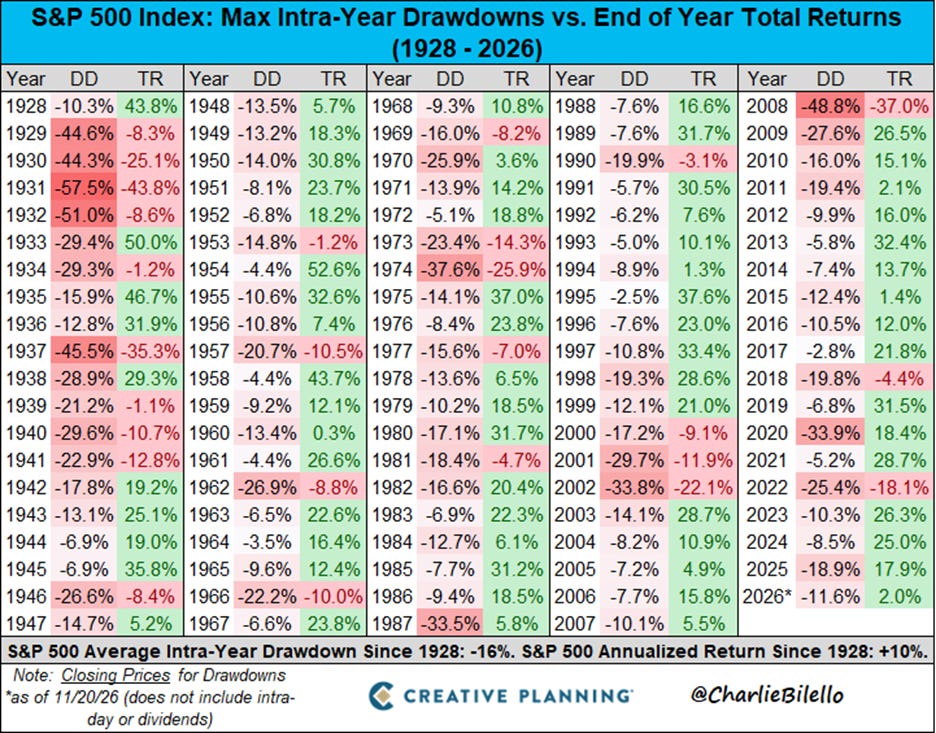
4. Though this was the worst drawdown of my retirement, and the portfolio now has a lower value than the day I retired, this was a scenario in our plan and is a reason we carry so much in the cash portfolio. This drawdown is mild historically (h/t @CharlieBilello via X)…see column DD for “DrawDowns”…column TR is for “Total Return”):
5. It isn’t all roses. Like most humans, I hoped the portfolio would be rallying right out of the gate to either provide more cushion or allow for a lifestyle upgrade. That will have to wait. In the meantime, there is no need to tighten the belt, de-risk the portfolio, sell the house, or get a job. I’m grateful that retirement is awesome just the way it is.
Brief Thoughts on Markets
Nothing really worked in global equities last week. Unless you were net short, you were down. Treasuries were finally a nice hedge to stocks. Gold, commodities, and crypto were not. Terrific earnings and constructive guidance from Nvidia, a well-received IPO from Anthropic, and good Wal-Mart and Target earnings reports (indicating a healthy consumer) did absolutely nothing to help.
This is indicative of de-risking and de-leveraging rather than any current fundamental problems. High volatility leads to hedge funds reducing leverage. A drawdown leads to anybody with a margin loan reducing borrowing to preserve portfolio values (usually voluntarily, but sometimes the lender seizes and sells collateral). It sometimes also leads to de-risking from clients of funds and ETFs when they aren’t in a dip-buying mood, forcing those funds to sell to meet redemptions.
Narratives shift toward bear cases as price changes drive story changes. Newspaper headlines and magazine covers get hyperbolically gloomy. Lawyers start suing every company whose stock is down more than 20% for securities fraud.
Sometimes price changes drive fundamental change such as companies that are dependent on external financing to fund future commitments, other growth initiatives, or debt refinancing. If financing becomes more expensive than the return on the future commitments, the company’s finances become even more fragile and a doom loop could ensue.
Other companies such as asset and wealth managers (including those inside of banks) get paid based on the market value of the assets they manage. Their own clients tend to act pro-cyclically, adding to their accounts in bull markets and withdrawing when stocks are falling.
Finally, the wealth effect is real. Retirees like me will naturally rein in spending. Pre-retirees will also feel the need to increase savings to fill market value holes. Airlines, hotels, auto manufacturers, homebuilders, luxury retailers, etc. could see sluggish demand. Especially those with a big presence in Silicon Valley, Austin, or Seattle.
This price action is normal.
As always, leverage is punished, whether in an individual stock or with a fund.
As a retiree, I prefer to avoid leverage myself (I would use it to shift tax liability between years or if I got a sweetheart interest rate like in 2021) and I prefer to avoid investing in companies that are dependent on the kindness of capital markets or banks.
The market will reach an equilibrium level where de-leveraging and de-risking is balanced by value seeking, either from investors or from companies buying back their own stock.
At that point, the narrative will change again. You will then hear more hopeful stories about the future, multiples will expand, and long-term earnings growth estimates will rise. Volatility will recede and hedge funds will re-lever. Animal spirits will feed on themselves and other investors will shift from cash and bonds to stocks, and finally, will also re-lever.
As for timing the bottom, that’s not my thing, but I’m going to tell you what I’d theoretically do anyways!
I’d get excited if every one or two of the rocks I turned over resulted in a potential buy (they are still rare outside of AI stocks that look washed out). At that point, I’d probably consult charts to ensure whatever I am interested in has settled down. If both those things happen, I’d reduce my cash allocation from six years to five or even four if things get juicy. If not, I’m only in trouble if this correction doesn’t correct itself before I run out of cash! Here is hoping to a full recovery no later than 2031.
Have a great week and Happy Thanksgiving to those who celebrate!
Discussion about this post